Salem
This has been on my mind the past few weeks.
We’re speed walking into an era where using AI has turned into an excused for a witch hunt, but I’ve noticed it getting worse lately.
A blog post, a tweet, an illustration, an entire product. The what doesn’t really matter. The response is nonetheless automatic:
“AI slop!”
“ok thx ChatGPT”
Someone spots an em dash, a sentence that feels a little too polished, or an image with that "AI look" and the trial is over before it started. Concern shifts from the work to the method and out come the gallows.
Now, I’m not entirely against the criticism.
I’ve seen countless examples of downright lazy AI usage. Someone prompts ChatGPT, Claude, or whatever, immediately copies the result, and publishes it to the world. No editing. No verification. No thought beyond the original prompt. Then they act surprised when people can tell.
That version of using AI to do work drives me insane too. But there’s another side to this that bothers me more.
Sometimes it’s obvious that AI was involved, but it’s also obvious that the person cared about the result. They edited it, reorganized it, rewrote large parts of it, and threw out bad ideas. They added their own ideas, checked the claims, and made good ol’ fashioned human decisions. They took the raw result and evolved it into something they were willing to put their name on.
In other words, they did the work.
The tool may have contributed words, images, structure, or options, but the person still (presumably, to be fair) leveraged judgment. Without their prompts, thinking, and editing, the work in question wouldn’t have existed in its published form.
That’s not the same thing as pressing a button and shoveling more crap onto the internet. Yet those two things are increasingly conflated.
This is the part that’s starting to feel like Salem to me: the accusation has superseded judgment. And once the label is applied, context is presumed irrelevant.
The quality of the work doesn’t matter. The amount of effort doesn’t matter. The intent doesn’t matter. The person is contaminated, therefore the work is contaminated, therefore it can be dismissed without further thought. Fucking lepers!
But let’s be honest: that isn’t criticism, it’s a purity test.
Now don’t get me wrong. There are plenty of legitimate reasons to dislike AI.
Engineers getting laid off under the pretense that AI can replace them. Artists seeing their work absorbed into a model without permission. Small, rural towns getting gaudy, cement-block data centers dropped in their backyard. Watching companies use AI as cover for cutting costs, lowering standards, and flooding the internet with garbage.
I understand the anger. AI has caused me plenty of trouble in my own business.
I’m not arguing that anyone should stop being angry. I’m not arguing that everyone should use these tools. I’m not even arguing that all of this ends well. I’m about 60% convinced this ends in some kind of demi-biblical disaster.
But turning that anger toward every individual who uses AI is not going to solve any of those problems. It just redirects the anger toward the easiest available target.
The stranger-than-fiction consequence of all this is that people are beginning to perform imperfection to prove they’re human.
Writers remove em dashes because they’re afraid someone will accuse them of using ChatGPT (despite the em dash being one of the sexiest pieces of punctuation the English language has to offer). They roughen up clean sentences. They leave awkward phrasing in place. Artists avoid certain aesthetics and compositions. Everyone becomes more secretive about their process because honesty risks becoming evidence against them later.
This should bother us. People have always used tools to help them create, yourself and I not excluded.
Spellcheck, cameras, templates, stock photography, code libraries...all tools just like AI.
Granted, AI is more invasive, more complicated, and raises much larger ethical questions than most of those things, but the big pink elephant question in the corner is still useful: "who made the meaningful decisions in the work the AI was used to create?"
Did the person have something to say? Did they shape the result? Did they reject bad output? Did they verify what they were publishing? Are they willing to take responsibility for it?
Or did they press a button and publish whatever came back?
Small distinctions, these are not.
The real danger here isn't someone using AI. It’s when they gradually hand over the parts of themselves that made the tool useful in the first place: their judgment, their curiosity, and their ability to recognize when something is wrong, hollow, or just a pile of hot garbage that nobody wants.
I posted this comment on Hacker News the other day, and I think it neatly explains what I’m getting at:
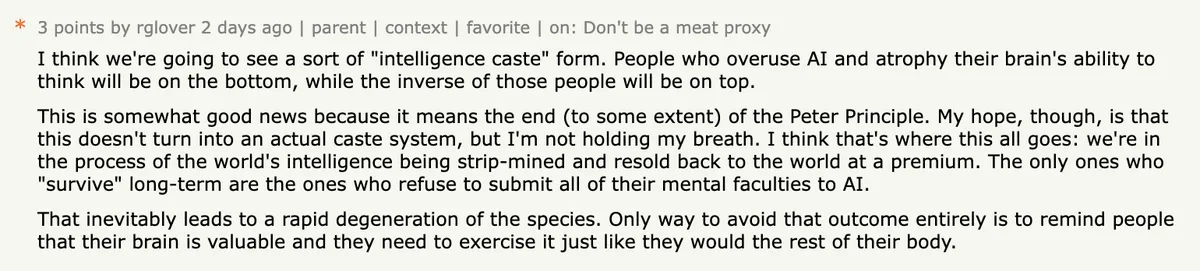
It’s safe to say the people of Salem were wrong. Despite their supernatural accusations being false, they still became self-fulfilling. Suspicion of someone being a "witch" was enough to consider them persona non grata. Once someone was marked, every denial they tossed back in response added to the evidence pile.
Soon enough (arguably, already), someone denying use of AI will be treated as 'evidence' of their uncleanliness too. Meanwhile, the actual systems causing harm continue onwards and upwards, uninterrupted.
The companies cutting jobs, scraping work, burning energy, lowering standards, and encouraging careless mass production just don’t care that someone got yelled at on Twitter for using Claude to reorganize a blog post.
The crusade targets individuals because individuals are easily-accessed. That doesn’t make them the right target.
You can hate AI. You can refuse to use it. You can argue for regulation, compensation, disclosure, limits, or its complete removal from parts of society. Those are all legitimate positions.
But once you stop looking at the actual work and begin searching for signs of contamination instead, you’re not evaluating it on rational grounds...
You’re conducting a trial.